NEW AEO Services - Get Found by AI Before Your Competitors Learn more →
NEW GEO Services Now Live — Dominate AI & Local Search Learn more →
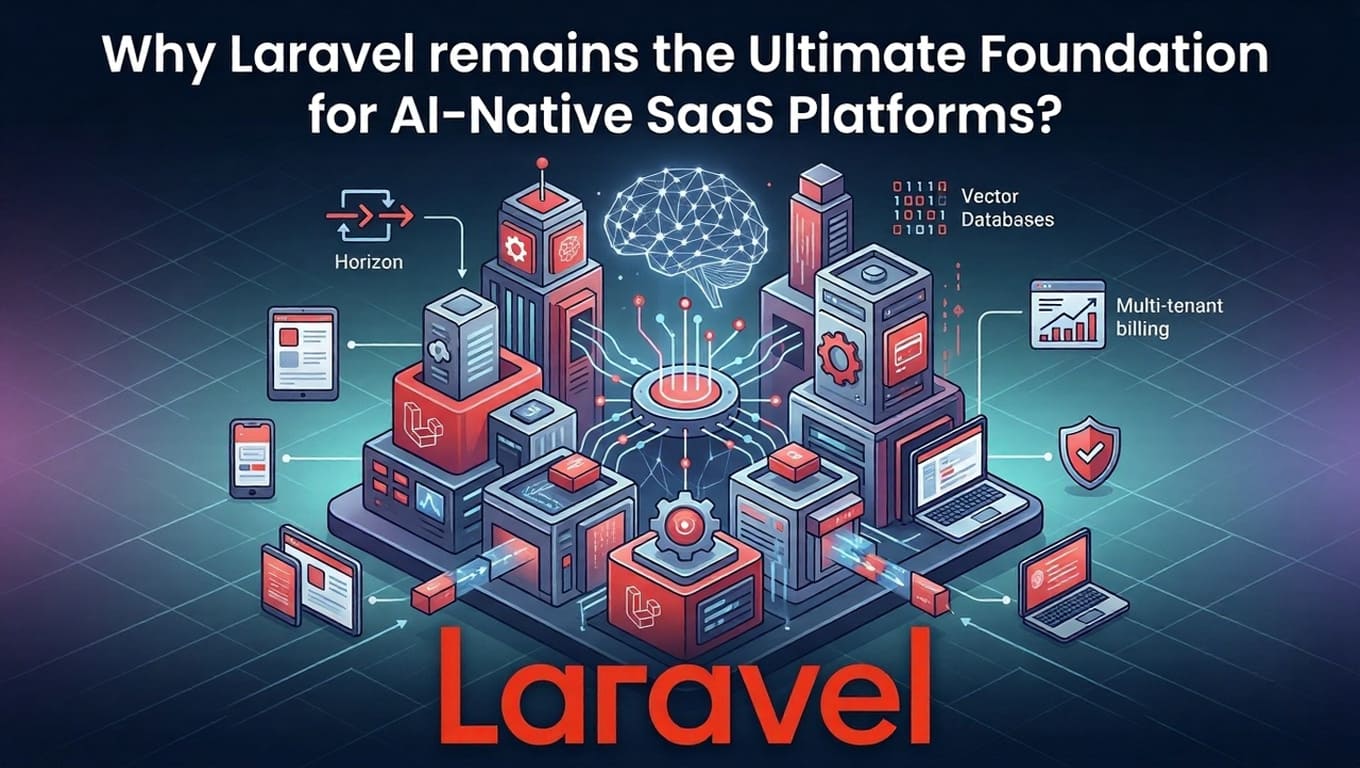
A decade-old PHP framework is quietly powering some of the most intelligent software being shipped today. Here’s the architectural case of Laravel as the backbone of modern AI-native SaaS.
The SaaS landscape is being rewritten by artificial intelligence. Every modern software product is now expected to reason, predict, summarize, or automate, not merely store and display rows of data. The shift toward AI-native SaaS platforms has pushed engineering teams to rethink their stack from the ground up.
Yet amid the noise around new frameworks and AI-first tooling, one mature web framework continues to power a disproportionate share of production-grade, intelligence-driven applications: Laravel.
Far from being a legacy choice, Laravel has matured into a framework purpose-built for the demands of intelligent, data-heavy, multi-tenant software. Its combination of elegant syntax, battle-tested architecture, and a thriving ecosystem of first-party tools makes it uniquely suited to the asynchronous, API-driven, and computationally intensive workloads that define AI-native products.
An AI-native SaaS platform is fundamentally different from a traditional CRUD application. It needs to call external large language models, generate and store embeddings, run inference asynchronously, and serve results in near real time, all while supporting hundreds or thousands of tenants on shared infrastructure.
Choosing a framework for this kind of product is not just a backend decision; it determines how fast a team can ship features, how gracefully the system handles unpredictable AI latency, and how cheaply it scales. This is precisely where Laravel’s architecture earns its reputation, because it was designed from the outset to manage complexity without descending into chaos.
At its core, Laravel offers a clean MVC structure paired with the Eloquent ORM, which lets developers model AI-related entities, conversation threads, embeddings, usage credits, and prompt legs as expressively as any other business object. The framework’s service container and dependency injection system encourage teams to isolate AI logic dedicated, testable service classes rather than scattering model calls throughout controllers.
This separation of concerns matters enormously once a product integrates multiple AI providers, fallback models, and custom business rules; Laravel’s structures keep that complexity organized rather than tangled.
AI workloads are inherently latency-heavy. Generating embeddings, running document extraction, or waiting on a model’s response can take seconds rather than milliseconds, and no SaaS product can afford to block a user’s request while that happens.
Laravel’s native queue system and job classes let teams offload these tasks to background workers automatically, complete with retries, exponential backoff, and rate limiting for third-party API calls.
Laravel Horizon then gives engineering teams a real-time dashboard into queue throughput, failed jobs, and worker health, which is essential visibility when AI providers experience downtime or throttling.
An AI feature is only as reliable as the infrastructure quietly processing it in the background, and Laravel treats that infrastructure as a first-class citizen.
Laravel Octane, which runs the application on high-performance servers like Swoole or RoadRunner, keeps the framework booted in memory between requests instead of reloading it from scratch every time. For AI-native SaaS platforms serving high volumes of API requests, this dramatically reduces response overhead.
On the deployment side, Laravel Vapor brings serverless, auto-scaling infrastructure to the framework, allowing AI-heavy endpoints to scale elastically during usage spikes without manual provisioning, a critical advantage when AI features can cause unpredictable traffic patterns.
AI-native products rarely exist as a single monolith; they orchestrate calls to external model providers, internal microservices, and third-party data sources. Laravel’s API-first architecture, backed by Laravel Sanctum and Passport for token-based authentication, makes it straightforward to expose secure, versioned APIs for mobile clients, partner integrations, or AI agents.
The built-in HTTP client simplifies calling external services such as language model APIs, while consistent JSON response formatting keeps frontend and AI orchestration layers in sync.
Multi-tenancy is the backbone of any SaaS business, and Laravel’s ecosystem has matured to address it directly. Packages built around multi-tenancy patterns allow teams to isolate tenant data at the database or schema level, while Laravel Cashier handles subscription billing, metered usage, and proration logic, all of which are essential for AI products that bill by token consumption or API call volume.
Authentication scaffolding through Jetstream or Fortify, combined with an admin panel like Nova, lets small teams ship enterprise-grade SaaS features without building this plumbing from scratch.
The Laravel community has moved quickly to support modern AI patterns. Integrations with vector databases such as Pinecone, Weaviate, and the pgvector extension for Postgres allow Eloquent models to store and query embeddings alongside regular relational data.
This makes building a retrieval-augmented generation (RAG) pipeline, where relevant documents are retrieved and injected into a prompt before calling a language model, a natural extension of existing Eloquent relationships rather than a separate, bolted-on system.
AI-native SaaS platforms often process sensitive customer data that feeds directly into third-party models, which raises the stakes on security. Laravel ships with CSRF protection, encrypted cookies, hashed credentials, and a policy-based authorization system out of the box.
This enterprise-grade security foundation, combined with mature support for audit logging and data encryption, helps teams meet compliance expectations such as SOC 2 or GDPR when handling data that ultimately trains or informs AI features.
Laravel’s developer productivity advantage compounds over the life of a product. The Artisan command-line tool accelerates scaffolding, the Spatie package ecosystem covers everything from permissions to media handling, and a large, active global community means answers and battle-tested packages already exist for most AI integration challenges.
Hiring is easier too: Laravel remains one of the most widely adopted PHP frameworks, so teams can scale engineering headcount without struggling to find qualified talent.
This combination of speed and structure is why Laravel shows up at both ends of the company spectrum. Early-stage startups use it to ship an AI-powered MVP in weeks rather than months, while established enterprises rely on its stability and ecosystem maturity to bolt AI capabilities onto existing SaaS products without a full rewrite. Few frameworks offer that same range, from rapid prototyping to long-term, high-scale maintainability.
AI-native SaaS platforms demand a foundation that can handle asynchronous workloads, scale elastically, integrate cleanly with external AI services, and support multi-tenant billing, all while remaining secure and maintainable.
Laravel checks every one of these boxes, not because it was built with AI in mind from day one, but because its underlying architectural decisions, expressive ORM, robust queueing system, API-first design, and a deep ecosystem, turned out to be exactly what intelligent software needs. For teams building the next generation of AI-driven SaaS products, Laravel isn’t just still relevant; it remains one of the most dependable foundations available.






 +91 9836 720 921
 +91 9836 720 921
 saha@zenithsolz.com
 soumya.seo@outlook.com


