NEW AEO Services - Get Found by AI Before Your Competitors Learn more →
NEW GEO Services Now Live — Dominate AI & Local Search Learn more →
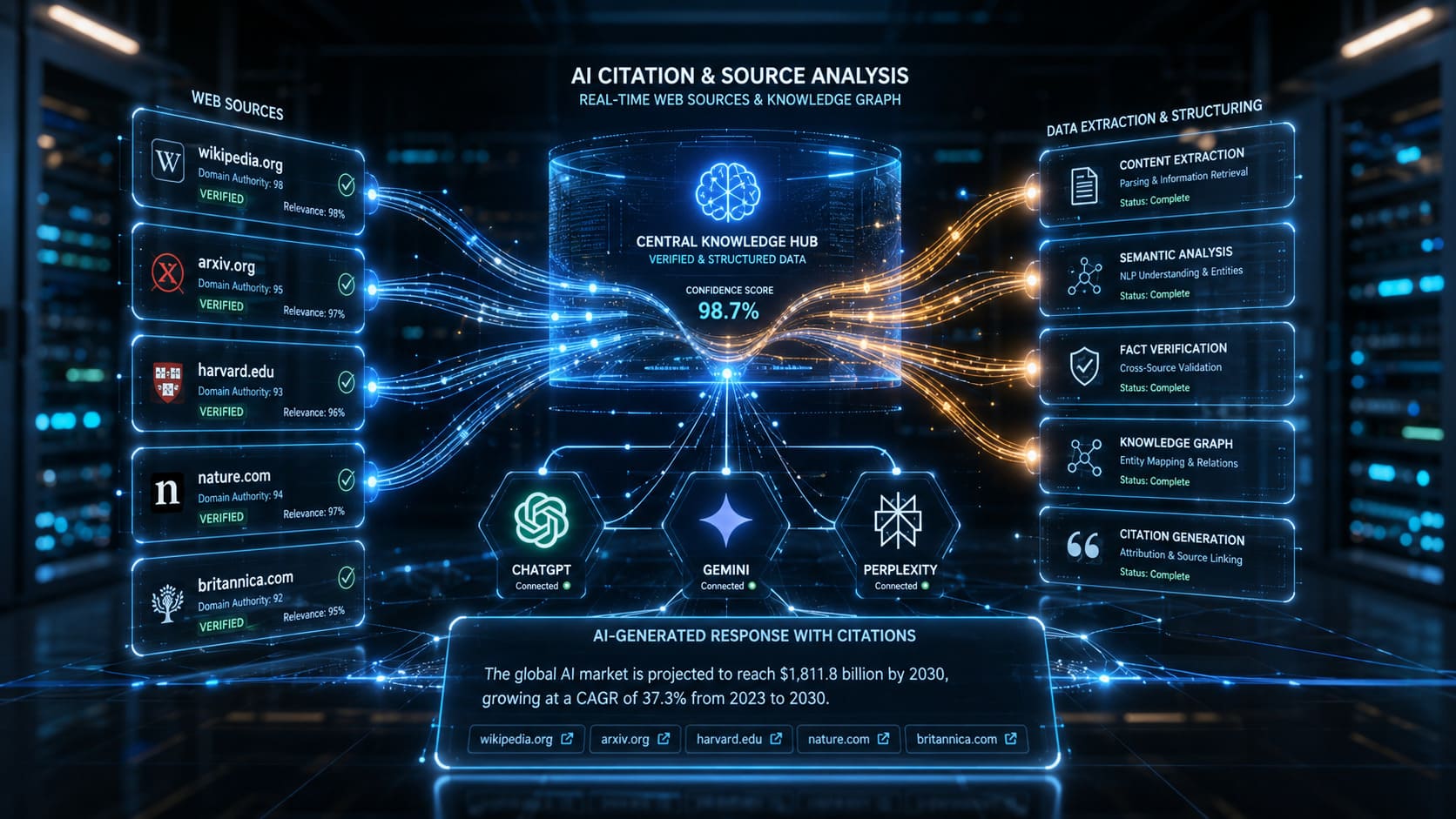
AI has revolutionized the way users seek information. Now it’s common to skip clicking through ten blue links. People prefer asking tools such as ChatGPT, Gemini, or Perplexity straight out, then receiving quick answers that come with sources listed. Because of this shift, those built-in references matter just as much to companies, writers, and media makers as topping regular search results once did.
When brands understand what grabs attention on these platforms, visibility grows without extra effort. How content gets shared shapes where it appears online now. Seeing patterns in posting helps messages reach further naturally. What works today shifts constantly, yet clarity always stands out. Through observation, better placement follows almost by itself.
If someone mentions your website, article, research paper, or company page in their answer, it can drive highly engaged users who are actively looking for answers to your content. AI-generated answers tend to cite a few sources that are presented in a limited way, so the citations have much greater impact.
Citing is beneficial because it offers the following benefits:
Increased industry thought leadership.
But not every piece of content has an equal opportunity of being chosen.
Depending on which version someone uses, how ChatGPT gives credit changes. When online, it tends to pick sources that matter – ones that show clear signs of being trustworthy and useful. Some factors that might impact the selection include:
ChatGPT is designed to generate information and not just to copy and paste it. Thus, resources that are highly original and comprehensive will have a higher likelihood of being cited.
Google’s knowledge of the web is tremendous, and often, Gemini will follow familiar rules that SEO’s know.
Google has long focused on the quality of its content, and included ideas like:
Many of these same signals are important to Gemini as well.
Content creators should concentrate on:
Technical optimization is important as well. Because of these details, machines that scan web pages can make sense of material faster. What happens is clarity grows when structure supports meaning. Machines notice patterns where organization exists. When pieces fit clearly, understanding follows more naturally. Systems respond well to signals that show intent. Where logic shows up, responses become sharper. Clarity comes through when parts connect without confusion.
Unlike many AI assistants, citations are part of the user experience of using Perplexity.
It seems to prefer content that is:
Perplexity often surfaces:
Pages that solve specific queries directly can outdo others in particular.
For instance, an article entitled:
How the California 2026 Intangible Asset Rules Will Impact Software Companies”
may be more likely to be cited than a generic title, such as:
Thoughts on New Tax Changes.
Specificity enables AI systems to align the content with the user’s goals.
While no strategy ensures AI citations, some practices can enhance visibility.
Natural language queries are commonly used as the starting point for many AI interactions.
You might add sections like:
This format is very similar to the natural search paradigm.
Thin content is not interesting.
Instead of creating a series of short posts, make the effort to create comprehensive resources that describe:
When a body of work is complete, it can be a more popular reference point.
Well-organized pages are good for AI systems.
Best practices include:
Well-formatted data is easier to read by humans as well as machines.
There is tons of information available on the web that is generic.
To differentiate your content:
Content is valuable when it has unique perspectives.
Older pages lose their relevance over time.
Check key articles on a regular basis to:
AI systems that look for more up-to-date information might prefer more recent resources.
The traditional SEO is changing to something more wide-ranging. There are new terms like Generative Engine Optimization (GEO) or AI visibility optimization that many marketers now discuss, specifically, how large language models find, understand, and reference information.
First place on a search engine page isn’t the objective anymore. It is slowly emerging as one of AI systems’ trusted sources to confidently cite when users ask critical questions. Given the increasing importance of conversational search and the fact that it’s being cited by tools like ChatGPT, Gemini, and Perplexity, such citations could represent one of the most valuable sources of digital visibility.






 +91 9836 720 921
 +91 9836 720 921
 saha@zenithsolz.com
 soumya.seo@outlook.com


