NEW AEO Services - Get Found by AI Before Your Competitors Learn more →
NEW GEO Services Now Live — Dominate AI & Local Search Learn more →
What makes the next generation of digital marketing agencies? Innovative, consultative, or automation-driven? The way out is to base AI on an AI-first basis, as opposed to testing white-box AI tools.
An agency based on AI has AI as its core service. It does not view artificial intelligence as a support mechanism but as the system that is the source of value creation, client outcomes, and scalability.
The opportunity is clear. According to McKinsey, generative AI has the potential to contribute to an annual increment in productivity growth in industries by 4.4 trillion. Boston Consulting Group supports the fact that AI-first companies grow quicker with smaller teams and develop a completely different competitive edge.
But the majority of businesses are not that mature. Ninety-two percent of the businesses intend to invest more in AI, yet just one percent of them view themselves as being AI mature.
The concept of an AI-first service agency is not actually an organization that introduces AI-related utilities to the current work processes. It is the place where any form of AI becomes the backbone of operation, which affects the development of services.
These agencies re-architect workflows around intelligent agents that can run and change on the fly instead of manual processes or passive automation.
These AI agents deal with optimization of the campaign, content creation, client reporting, and workflow coordination. Human teams are interested in strategy, general control, and morality.
Customers do not just test the instruments, but seek partners that can integrate AI into their business. Simply put, the AI-first agency is formed with the purpose of integration, acceleration, and maturity- the features of differentiating the leaders and the lag-ghosts of the AI age.
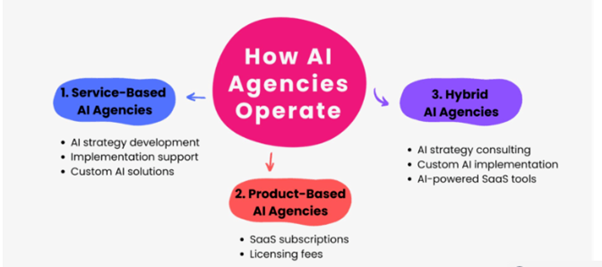
Now, before we delve into the next section, we shall look at the operation of AI agencies.
In the situation when the performance that you require cannot be ensured by a human-driven digital marketing agency, collaborating with an AI-first agency is a smart idea. These benefits are scale, speed, financial returns, and human creativity.
Without increasing the number of heads, growth is possible.
AI-first agencies have AI agents to delegate the workload to machines, and humans manage the strategy and ethics. Repetitive workflows, like reporting, media optimization, and creative production, can be automated in order to allow agencies to deliver to more clients without an equivalent increase in cost.
The engine of AI agents is the implementation.
Artificial intelligence-first companies have leaner teams that achieve better results than traditional ones.
The cognitive technologies are able to liberate business teams, as they are not engaged in monotonous labor, but rather work on the areas that machines are not able to take over. The redistribution generates two values:
With AI maturity, an AI-first service agency intertwines AI into the operations of a client and delivers value more quickly than the client can independently.
Creative to automation positions, AI agencies are able to improve annual productivity by redesigning workflows in which AI can substitute or supplement human labor.
Experimentation with no integration is known as the AI maturity gap. AI-first agencies bridging that divide by:
The teams in AI-first agencies are reorganized by:
The usage of AI that is not regulated poses risks. An AI-first model needs real-time governance, embedded policy, and executive alignment. Businesses lack the structures that agencies offer:
An AI-first service agency offers services that are significantly different from compared of a traditional agency.
Creative services
Creation of content, conceptual testing, active campaigns, and hyper-personalization.
Marketing services
Targeting by artificial intelligence, campaign optimization, and automatic reporting.
Automation services
Orchestration of workflow, automation of processes, and integration of multi-agency systems.
Consulting services
AI-based diagnostics and predictive scenario models, and playbooks.
The fact is that agencies cannot simply pour AI onto the old methods of work and hope that they will change. An AI-first service agency is a service agency that constructs services with AI agents to do the grind, and people can do what they can do best, which is strategy, creativity, and establishing trust with the clients.
One AI-first agency could allow campaigns to change in real time, or be a creative agency where ideas are tested and personalized to millions as soon as they are generated. It might be an automation agency to strip the workflows of friction or a consulting agency to transform AI experimentation into a reality.
At the core of it, AI-first agencies will always develop new opportunities. And as more companies capitalize on AI but still scuffle to make it work, the ones built on AI-first philosophies will be the ones that set the pace.
An AI-first service agency puts artificial intelligence at the heart of its operations, integrating AI in all its work processes to provide customer results and solutions that are scalable.
They provide fast outcomes, real-time information, increased ROI, reduced operating expenses, and enhanced innovation, automating repetitive processes.
Some of its services are AI-based content creation, campaign management, real-time reporting, workflow management, and AI integration advice.
These agencies have implemented real-time governance, policy structure, and uphold bias, privacy, and ethical standards in the use of AI.
The process of transition will demand re-architecturing workflows, retraining teams, and installing AI in daily processes to reach real AI maturity.




 +91 9836 720 921
 +91 9836 720 921
 saha@zenithsolz.com
 soumya.seo@outlook.com