NEW AEO Services - Get Found by AI Before Your Competitors Learn more →
NEW GEO Services Now Live — Dominate AI & Local Search Learn more →
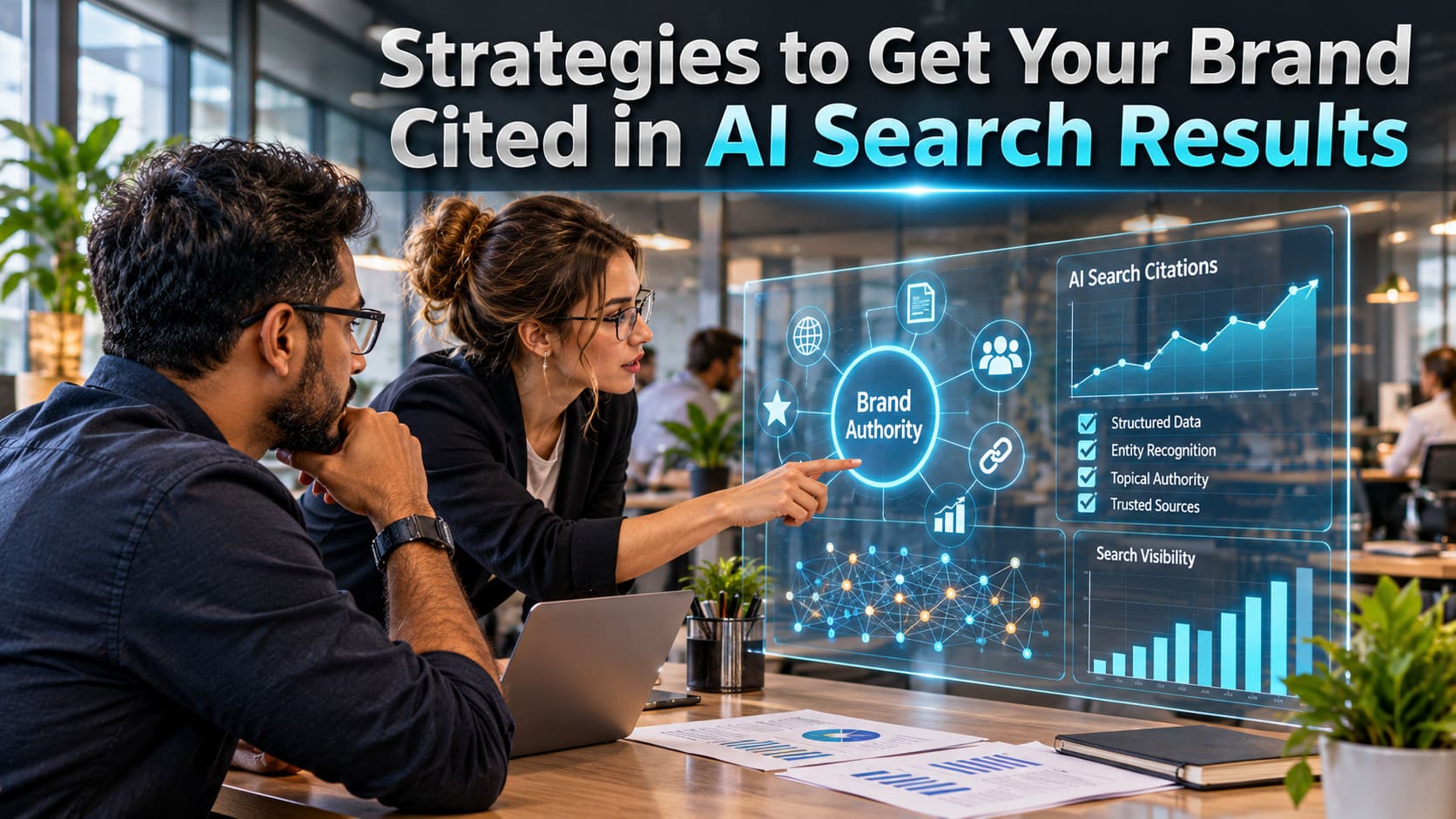
SEO isn’t merely about getting to the top of Google. As platforms like ChatGPT, Google AI Overviews, Perplexity, and Microsoft Copilot alter the way information is found by users, businesses need to factor in where their content is showing up in AI-generated responses.
This change has brought about a new approach called Generative Engine Optimization (GEO), which concentrates on enhancing the accessibility of brand information for AI systems to find, understand, trust, and cite. While traditional SEO is relevant, there is a need to focus more on factual accuracy, originality, recognizability, and credible sources in GEO.
To boost your brand’s presence in AI-generated responses, let’s consider some practical strategies:
Fact-based statements may require reliable evidence for use by AI systems. Original studies, customer insights, surveys of the industry, and proprietary statistics will provide your site with content that can be cited by others.
For instance, in a logistics firm, researchers could post information about the impact of RFID on inventory accuracy in warehouses. It does not restate industry statements that are widely available, but can include its own results, describe how it was done, and include supporting information.
Consider these approaches:
Journalists, industry publications, and AI-generated answers will find your website a valuable resource when it comes to original research.
The generic content is often the same information that is found on thousands of sites. Your content has more depth and a recognizable source of knowledge from the expert commentary.
Use quotes from professional, company experts, researchers, and industry practitioners. Their contribution should be practical explanations, original observations, or informed opinions.
For stronger results:
Talking about technical processes, industry problems, product applications, and professional recommendations is especially beneficial when based on first-hand experience.
AI-generated answers are enriched with information that can be verified with reliable sources. When incorporating supporting statements into your content, be sure to use authoritative resources to back up your statements, which makes your content more transparent and easier to verify.
For instance, articles on Taxation may refer to government tax institutions, and any medical content may focus on medical institutions or research conducted by the medical community.
Useful practices include:
Remember that simply adding numerous external links does not guarantee AI citations. It is better to have fewer links, but they have to be relevant, accurate, and well-explained.
AI systems must possess knowledge of the business’s operations, its sector, and its association with other known objects.
This is where the clarity of the entity is important to GEO.
Begin by presenting your brand with a simple description. Describe its products, services, location, expertise, and target audience.
For instance, instead of saying that a company is a hotbed for innovation in the industry, describe it as a company that helps retailers with RFID inventory tracking solutions at their warehouses and distribution centers.
Ensure consistency of information on:
Uniformity is the driving force for search engines to differentiate your brand from other businesses with the same name.
AI systems must be able to find the relevant information easily. Well-structured information helps the reader grasp the details of each topic and locate specific information.
Don’t use lengthy paragraphs that string together several unrelated ideas. Rather, structure articles around specific questions and offer concise answers before going into the details.
Some helpful formatting tips are:
For instance, an article on RFID technology should include separate paragraphs on what RFID is, how it works, its uses, and the benefits of its use.
Article marketing is tough in terms of building up a recognizable niche if you are publishing articles on unrelated topics. It’s better to create detailed content on specific topics. Make a main pillar page about a broad topic and include detailed articles that answer questions that fall under the main topic.
For instance, a tax consulting firm may be able to create a content cluster on IRS audits, tax debt settlement, installment agreements, penalty abatement, and Offer in Compromise. Link articles together with appropriate internal links. This produces a sensible information structure and helps search engines understand the relationship between various pages.
Focus on:
Making sure that information is kept up to date when regulations and industry practices evolve.
Technical SEO is not part of GEO. Accessible websites and information are still necessary for AI-driven search experiences. Entities of a website and relationships between them can be described with structured data, and especially with Schema.org markup.
If your business is like any other, you should consider putting into effect:
Don’t forget your website has:
Although structured data can help to explain information, it does not ensure that an AI platform will cite your website.





 +91 9836 720 921
 +91 9836 720 921
 saha@zenithsolz.com
 soumya.seo@outlook.com


