NEW AEO Services - Get Found by AI Before Your Competitors Learn more →
NEW GEO Services Now Live — Dominate AI & Local Search Learn more →
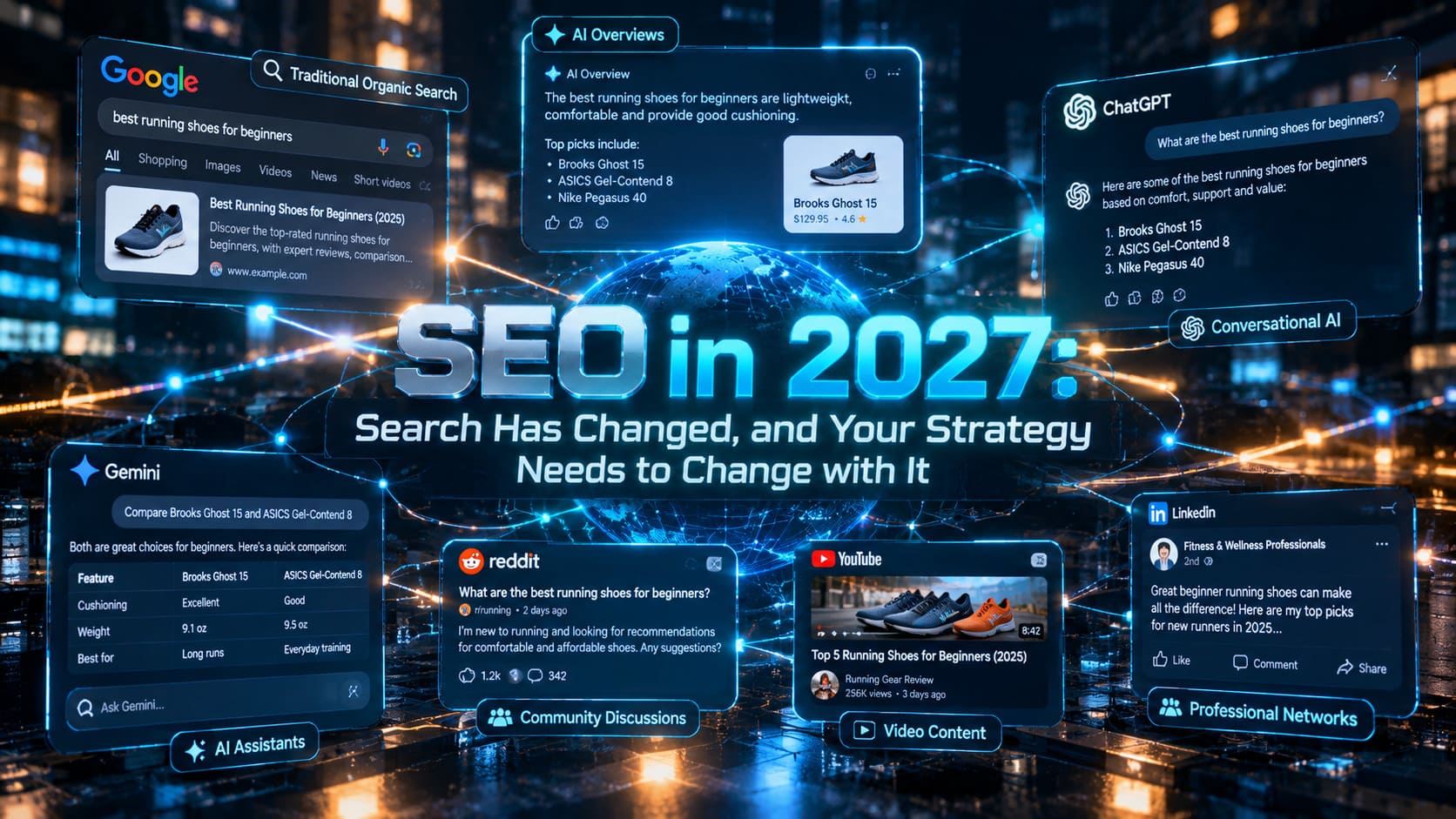
For years, SEO planning followed a familiar pattern. Find keywords with demand, create pages around those terms, optimize titles and headings, earn links, improve rankings, and measure the resulting organic traffic.
That framework still has value. But it no longer describes the entire search journey.
People now move between Google, AI Overviews, AI Mode, ChatGPT, Gemini, Claude, Perplexity, YouTube, Reddit, LinkedIn, forums, and other communities while researching products, services, companies, and problems. Sometimes they click through to a website. Sometimes an AI-generated answer provides enough information that they never need to.
The question facing businesses heading into 2027 is therefore bigger than:
It is increasingly:
“How do we make our brand discoverable, credible, and worth recommending wherever our audience searches?”
This shift is at the heart of the changing SEO landscape. Recent industry analysis makes a similar case: SEO is becoming less about optimizing for one channel and more about understanding the user wherever discovery happens.
For businesses, marketers, and SEO professionals, that requires a significant change in thinking.
At Zenith Solz, we see SEO, AEO, GEO, AIO, content, brand authority, community engagement, and digital PR becoming parts of a much more connected search visibility strategy.
And the businesses that understand that connection early could have a considerable advantage.
Every major change in search seems to produce another declaration that “SEO is dead.”
It isn’t.
Google remains enormously important. Traditional organic search continues to generate significant discovery, traffic, and commercial intent. Technical SEO, crawlability, indexing, internal linking, content quality, backlinks, site architecture, search intent, and keyword research aren’t suddenly obsolete because people use ChatGPT.
What has changed is the environment surrounding them.
Google’s AI Overviews have moved beyond being a small experiment. AI Mode adds conversational discovery directly into Google Search, while Gemini has become increasingly integrated into Google’s broader ecosystem. Outside Google, consumers are using ChatGPT, Claude, Grok, Perplexity, and other AI platforms for questions they previously would have typed into a traditional search box.
That means a company could theoretically have excellent traditional SEO metrics and still have visibility gaps.
You might rank strongly for an important keyword, for example, but be absent when someone asks an AI assistant:
“What are the best companies for solving this problem?”
Or:
“Compare Company A, Company B, and Company C.”
Or:
“What are people saying about this product?”
Or:
“Which provider would you recommend for a small business?”
Ranking remains valuable.
But being part of the answer is becoming valuable too.
AI Search Is Growing, but Google Still Matters Enormously
It is easy to overreact to the growth of AI search.
That would be another mistake.
Experts cite Shopify analysis showing AI-referred sessions to merchant storefronts growing 197% year over year during Q2. Those visitors reportedly converted at roughly twice the rate of organic visitors in research-heavy categories.
At the same time, organic search still delivered more traffic than all tracked AI platforms combined, and itself grew 12% from a substantially larger base. The original article appropriately treats the findings as directional because Shopify did not disclose the number of merchants included in the dataset.
The implication isn’t that companies should move their SEO budget from Google to ChatGPT.
It is that businesses need to recognize two realities simultaneously.
Google remains a major acquisition engine. AI search is becoming another meaningful discovery and decision-making layer.
The smarter strategy is therefore additive rather than destructive.
Don’t replace SEO.
Expand what SEO means.
The rise of AI search has produced an expanding vocabulary: AEO, GEO, AIO, LLM optimization, AI SEO, AI Search Optimization, and several other terms.
The terminology is useful when it helps explain different search environments. It becomes less useful when businesses create completely isolated strategies for each one.
The underlying objective remains remarkably consistent:
Understand what your audience wants, create something genuinely useful, establish credibility, and make that information easy for search and AI systems to discover and understand.
Traditional SEO asks whether Google can find, understand, trust, and rank your information.
AEO asks whether answer systems can confidently extract useful answers from it.
GEO considers whether generative engines can understand, cite, mention, or recommend your brand and information.
Brand marketing influences whether people recognize and trust the company once they encounter it.
Community participation creates independent conversations and experiences around the brand.
Digital PR builds third-party validation.
These aren’t unrelated disciplines anymore.
They increasingly reinforce one another.
One of the strongest ideas by the experts is also remarkably simple. Rather than obsessing over every possible ranking factor inside every AI model, marketers can start with three questions:
These questions can completely change a content strategy.
Consider a SaaS company publishing another generic article titled “What Is CRM Software?”
An AI assistant can probably explain CRM software perfectly well without that article.
Thousands of existing websites already explain it.
So, what does article number 10,001 contribute?
Now imagine the same company publishes anonymized findings from 50,000 customer interactions showing where sales teams most frequently lose qualified leads.
That information belongs to the company.
Competitors cannot simply reproduce it without copying the research.
Journalists may reference it.
Customers may discuss it.
Bloggers may cite it.
People may link to it.
AI systems may encounter multiple independent sources referencing the findings.
That is a much more defensible content asset.
The difference isn’t word count or keyword density.
It is information gain and originality.
AI search and community search are sometimes discussed as though one will eventually replace the other.
Human behavior suggests something more complicated.
Large language models are exceptionally useful when people want information synthesized. They can gather concepts, organize them, summarize options, and provide an accessible starting point.
Community platforms serve another need.
They provide individual experiences.
Someone researching software might ask ChatGPT:
“What should I consider when choosing accounting software for a 20-person company?”
Then they may search Reddit for:
“Has anyone actually used X accounting software with a 20-person team?”
The first question seeks synthesis.
The second seeks experience.
The user wants to know what happened to another human being.
Was implementation difficult?
Did customer support respond?
Did the product break?
Was cancellation painful?
Did the supposedly useful feature actually work?
That distinction explains why Reddit threads, YouTube walkthroughs, LinkedIn discussions, forums, reviews, and genuine customer conversations are becoming increasingly important parts of the broader search ecosystem.
Content from these environments can also appear in conventional search results and feed information ecosystems that AI systems use when generating answers.
SEO teams therefore need to stop viewing community engagement as something belonging exclusively to social media departments.
Traditional SEO has historically placed enormous emphasis on links.
Links remain important.
But modern search visibility also requires thinking about where and how a brand is being discussed.
Imagine hundreds of credible conversations across industry websites, Reddit, LinkedIn, YouTube, podcasts, review platforms, trade publications, forums, and specialist communities repeatedly associating a company with a particular category.
Not every mention will contain a backlink.
Yet collectively, those conversations create something valuable:
a recognizable brand narrative.
They tell humans—and potentially the information systems consuming those sources—what the company does, who it serves, what people think about it, and where it fits within its market.
That is why unlinked mentions shouldn’t automatically be dismissed as failed link-building opportunities.
Sometimes the mention itself has strategic value.
However, businesses should not try to manufacture this artificially.
Fake Reddit accounts, staged forum conversations, promotional Quora answers, fabricated reviews, and obviously planted recommendations aren’t genuine community authority.
Real authority comes from participating where customers genuinely discuss the category.
Keyword research isn’t disappearing.
But what businesses do after keyword research should change.
Instead of treating every keyword with measurable volume as an article opportunity, divide demand into three broad categories.
These often involve decisions or actions.
Examples include:
A user may obtain some information from an AI answer but still have a reason to visit the website.
These queries deserve serious investment.
These include straightforward definitions and simple informational questions.
“What is X?”
“What does Y mean?”
“How many Z are there?”
AI Overviews and conversational search can frequently answer these questions without requiring the user to visit another page.
That doesn’t automatically mean you should abandon informational content.
Some foundational content supports topical understanding, internal linking, customer education, and broader authority.
But businesses should reconsider the old strategy of publishing hundreds of thin definition pages simply because keyword tools show search volume.
Then there are searches such as:
Those conversations often belong naturally on Reddit, YouTube, forums, LinkedIn, review platforms, and other communities.
Trying to capture every one of them with another corporate blog article misses the reason people search that way.
They want humans.
Your strategy should therefore include genuine human participation.
This may be one of the most important content marketing questions for 2027:
Could an AI model produce essentially the same article without knowing anything about our company?
If the answer is yes, you may have a differentiation problem.
Generic content has always existed. Generative AI has simply made it dramatically cheaper and faster to produce.
Businesses can now generate thousands of polished articles containing technically correct but largely interchangeable information.
That makes generic information less scarce.
And when supply explodes, differentiation becomes more valuable.
Brands should therefore invest more heavily in information that comes from their own experience:
original research, proprietary data, expert interviews, customer insights, experiments, case studies, product testing, internal methodologies, real examples, informed opinions, lessons from failures, and practical experience.
The goal isn’t to avoid AI.
Use AI where it improves productivity.
But don’t allow AI to become the source of everything your company supposedly knows.
There was a period when “topical authority” sometimes became an excuse for publishing enormous numbers of pages.
If your company sold project-management software, the theory might have been to create articles targeting virtually every keyword containing “project management.”
That can quickly become content spraying rather than expertise.
A stronger approach is depth.
Instead of publishing 100 shallow articles, create a smaller ecosystem of genuinely valuable resources that answer related questions comprehensively and connect naturally.
Professionals from the industry make a similar observation: going deep on a topic can result in the same content cluster appearing across related AI prompts, whereas another long generic “what is” article may simply be resolved directly by an AI Overview.
Real topical authority should feel like expertise.
Not a spreadsheet filled with URLs.
There is an interesting paradox emerging.
The more capable AI-generated content becomes, the more valuable genuinely identifiable human experience can become.
Think about product reviews.
A beautifully structured 2,000-word generic article describing a product may contain plenty of information.
But one sentence from someone who has actually used that product every day for three years can answer something the polished article cannot.
That’s why businesses should invest in visible experts.
Let engineers explain engineering decisions.
Let consultants discuss what they see with clients.
Let founders explain difficult strategic choices.
Let technicians demonstrate how something works.
Let customers tell their own stories.
Let subject-matter experts disagree with conventional wisdom when their experience supports it.
AI can summarize expertise.
It cannot retroactively acquire the experience that produced it.
Video deserves particular attention.
Industry experts note that search systems increasingly treat video and transcripts as source material, with YouTube appearing in traditional results and as cited material in AI experiences.
This creates an opportunity that many SEO teams still underestimate.
A company could record an expert explaining a difficult customer problem, publish the full YouTube video, create accurate captions and transcripts, add chapters, produce a supporting article, create short LinkedIn clips, extract customer FAQs, and repurpose the underlying expertise across multiple discovery surfaces.
One genuine expert session can become a rich information asset.
Compare that with generating a generic stock-footage video accompanied by an AI voice reading an AI-written article.
The latter technically qualifies as video.
But it provides little primary-source value.
Format alone doesn’t create authority.
Experience does.
Search Strategy Is Becoming a Three-Dimensional Customer Journey
The old customer journey often looked deceptively simple:
Google → Website → Conversion
The modern journey can look very different.
Someone might discover a problem through LinkedIn, ask ChatGPT about possible solutions, search Google for companies, watch a YouTube comparison, read Reddit discussions, return to an AI assistant to compare shortlisted providers, visit two company websites, search the preferred company’s brand name, and finally convert through direct traffic.
Which channel deserves credit?
LinkedIn?
ChatGPT?
Google?
YouTube?
Reddit?
Direct?
The answer is probably that several contributed.
That is why search strategy needs to move beyond last-click thinking.
The objective isn’t merely to generate another organic session.
It is to influence the buyer throughout the decision process.
This is perhaps the hardest adjustment for SEO teams and clients accustomed to reporting organic sessions.
AI-generated answers can reduce clicks for certain informational queries.
That doesn’t automatically mean SEO performance is deteriorating.
Suppose organic sessions decline 15%, but qualified leads increase 12%.
Pipeline grows.
Conversion rates improve.
Branded search rises.
Customer acquisition cost falls.
AI referrals bring fewer visitors but significantly higher purchase intent.
Would you call that SEO failure?
Probably not.
Some blue-link traffic may disappear, but that shouldn’t dominate the conversation if conversions, pipeline, and CAC are improving.
SEO reporting therefore needs to become more commercially mature.
Rankings and traffic remain diagnostic metrics.
They shouldn’t automatically be the final definition of success.
Businesses entering 2027 should broaden their measurement framework.
Traditional metrics still matter:
rankings, impressions, organic clicks, CTR, backlinks, indexed pages, conversions, and revenue.
But additional signals deserve attention:
AI citations, AI brand mentions, recommendation frequency, visibility across important prompts, AI referral traffic, branded search growth, direct traffic, third-party mentions, community discussions, assisted conversions, qualified leads, pipeline, CAC, and ultimately revenue.
Not every AI interaction can currently be measured perfectly.
That uncertainty should be acknowledged rather than disguised.
But imperfect measurement is not a reason to ignore an increasingly important part of customer discovery.
The answer isn’t to abandon everything that worked before.
Technical SEO still matters. Keyword research still matters. Links still matter. Content still matters. Google still matters enormously.
What needs to change is the planning process.
Start with the audience rather than the keyword.
Understand where customers research.
Separate queries that deserve content from those AI can satisfy instantly.
Identify the questions requiring genuine experience.
Build primary-source information.
Develop recognizable experts.
Participate authentically in relevant communities.
Turn video into searchable knowledge assets.
Earn third-party coverage.
Make your brand and expertise understandable across the web.
Structure important information so both humans and machines can retrieve it.
And measure success according to business outcomes rather than traffic alone.
This is where SEO, GEO, AEO, AIO, content marketing, social media, digital PR, brand building, and analytics begin to overlap.
The departments may remain separate on an organizational chart.
The customer journey doesn’t care.
At Zenith Solz, we believe the next phase of organic marketing should be built around three outcomes:
Discovery. Trust. Selection.
First, can customers discover your brand wherever they begin searching?
That could mean Google, an AI Overview, ChatGPT, Gemini, YouTube, LinkedIn, Reddit, or another platform.
Second, when they discover you, is there enough independent evidence and genuine expertise for them—and increasingly AI systems—to trust what your company says?
Third, when they reach the decision stage, have you created enough differentiation to be selected rather than merely mentioned?
Traditional SEO contributes to all three.
But SEO alone cannot manufacture everything required.
Strong brands need technical accessibility, useful content, expert voices, primary-source information, third-party validation, community presence, video, digital PR, and consistent positioning.
That is why we don’t see GEO or AEO as replacements for SEO.
We see them as part of a broader evolution in how brands become discoverable and credible.
SEO Isn’t Dying. It’s Escaping the Search Results Page.
SEO has spent decades evolving alongside search engines.
Now the definition of “search” itself is expanding.
A search can be ten blue links.
It can be an AI Overview.
It can be a conversation with ChatGPT.
It can be an AI Mode follow-up.
It can be a Reddit thread.
It can be a YouTube video.
It can be a LinkedIn discussion.
Sometimes the user wants information.
Sometimes they want synthesis.
Sometimes they want evidence.
And sometimes they simply want another human being to tell them what actually happened.
The job of modern SEO is therefore not to force every journey through Google.
It is to understand where the audience goes, what they need at that moment, and what your brand can contribute that deserves to be discovered, trusted, cited, and remembered.
Going into 2027, perhaps the biggest SEO change isn’t another algorithm, AI model, ranking factor, or optimization technique.
It is the question marketers ask at the beginning.
Stop starting with:
“What keyword should we rank for?”
Start with:
“What does our customer need, where will they look for it, and why should they believe us?”
Get those questions right, and SEO becomes much more than rankings.
It becomes a strategy for making your brand visible throughout the modern discovery journey.





 +91 9836 720 921
 +91 9836 720 921
 saha@zenithsolz.com
 soumya.seo@outlook.com


