NEW AEO Services - Get Found by AI Before Your Competitors Learn more →
NEW GEO Services Now Live — Dominate AI & Local Search Learn more →
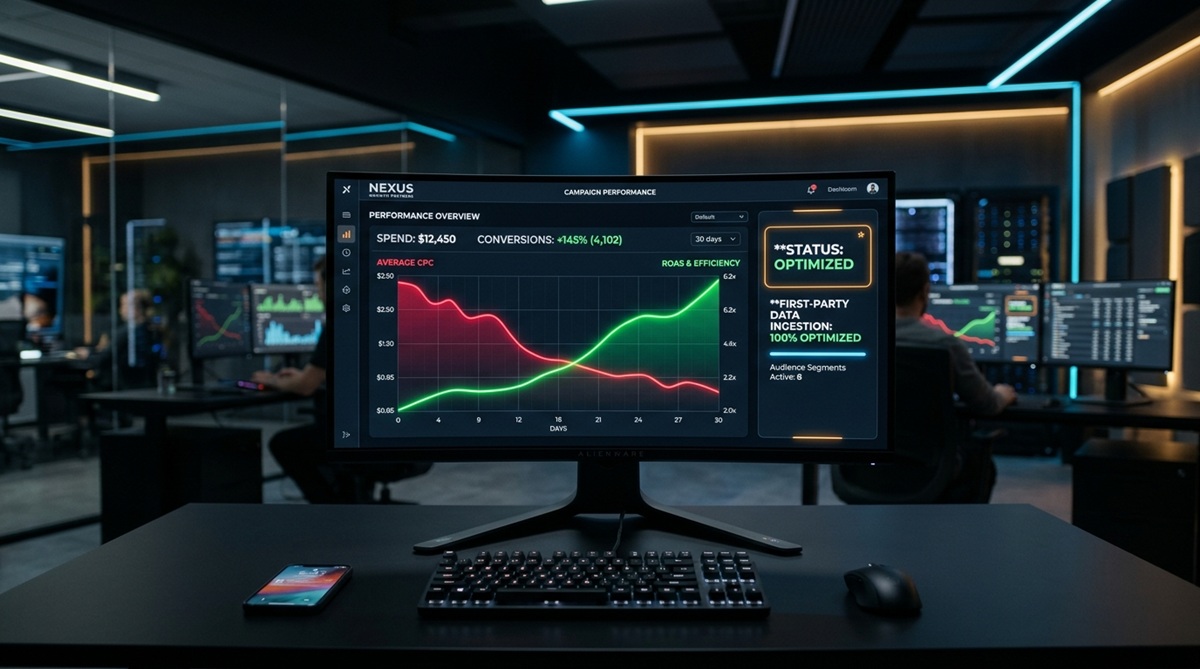
The world of Google Ads Cost Per Click (CPC) structural growth is not a glitch; it is the irreversible change caused by the intensified competition, automatization of the platform (AI), and harsher privacy regulations.
In 2026, it will not be enough to make changes in the bids or optimize a landing page. The advertisers have to use advanced, unnoticeable techniques to use the artificial intelligence and first-party data on the platform, which are required to be profitable.
Three key factors that enhanced CPC inflation are: enhanced rivalry (particularly of high-value verticals), Google moving to full automation (Performance Max/PMax), and the unavailability of third-party data that compels algorithms to offer high bids in order to locate the appropriate user.
The greatest pitfall is to use AI created by Google as a mere tool rather than as a learner. The majority of advertisers provide the AI with the generic data (such as simple conversion tracking and generic assets) and expect it to perform on the level of a world champion. The less obvious fact is that to educate the AI with high-value, human-confirmed information is the only method to teach an AI.
In order to successfully maneuver throughout the high-CPC landscape in 2026, start by targeting these five more sophisticated, data-driven optimization strategies:
The majority of the advertisers only feed the Performance Max (PMax) with various text and image resources. But what you really give us is the genuine competitive advantage, the Audience Signals.
As much as the three elements of Quality Score (QS), Expected CTR, Ad Relevance, and landing page experience are familiar, the hidden ingredient is to optimize situational relevance to boost your QS elements when making a bid artificially. A high QS is able to reduce your effective CPC by up to half the ad placement.
Remarketing is traditionally done with Customer Match lists. The further forward-thinking maneuver (not so obvious), but one that you can use with your high-value organic customer information, is to instruct the AI to identify newer, higher-paying customers.
In their eagerness to make the conversions, Performance Max tends to outbid you on searches of your own brand name, traffic that with a standard Brand Search Campaign with a high QS would have cost you little. This cannibalization is an expensive one.
Action: Use a special Brand Search Campaign (low budget, high QS) and subsequently request your Google rep to place an Account-Level Negative Keyword List that blocks your brand names out of your PMax campaigns.
The Edge: This activates the cheap, high-converting brand traffic into your committed Brand Campaign, leaving the PMax budget of the expensive to be used on non-brand discovery and on new customer acquisition, where the power of the AI is indeed required.
The feature of Google Ads frequently compels a decision between Exact Match, which is hyper-expensive, and Broad Match, which is hyper-wasteful. The strategic Phrase Match is the sweet spot of manageable CPC and volume to scale in 2026.
Phrase Queer: Mid-funnel research-intent keywords, including phrases like best CRM for a small business or alternative to [Competitor Name], should be engaged using Phrase Match. Combine with a carefully maintained, extensive negative keyword list updated every week.
The EEAT (Experience, Expertise, Authoritativeness, and Trustworthiness) criteria of Google, which is an SEO measure, are now becoming critical in paid advertising, mostly through the use of the Landing Page Experience QS feature. A landing page, which displays the knowledge of the high level (detailed and high-quality content) and motivates trust in it (transparent privacy policies, quick load, professional design), will get an Above Average rating. This will enhance your Quality Score, which will directly result in a lower CPC and an enhanced Ad Rank.
PMax (performance max) is a two-edged sword. It has the power to make you spend more on average CPC since it is designed to bid highly on high-intent signals on each channel. Nevertheless, when optimized efficiently with good Audience Signals (see strategy #1 and #3).
Target ROAS (tROAS) should be used when you possess a mass of high-quality conversion data and apparent and distinct values of products/services. But when you have a tight budget or more unreliable conversion information, it is safer to use Target CPA (tCPA), which has no focus on revenue, only efficiency (to achieve the conversion at a fixed price).





 +91 9836 720 921
 +91 9836 720 921
 saha@zenithsolz.com
 soumya.seo@outlook.com

